
Understanding a Central Government salary involves more than looking at Basic Pay.
An employee’s monthly salary can include Basic Pay, Dearness Allowance (DA), House Rent Allowance (HRA), Transport Allowance and other applicable allowances, while deductions such as NPS contributions and income tax determine how much ultimately reaches the employee as take-home pay.
This PayCorpus Salary & Pay hub brings these elements together.
Use it to understand the 7th CPC Pay Matrix, Pay Levels, Basic Pay, allowances, annual increments, salary calculations and in-hand pay—and to access calculators and detailed guides for individual topics.
Want to calculate your salary instead?
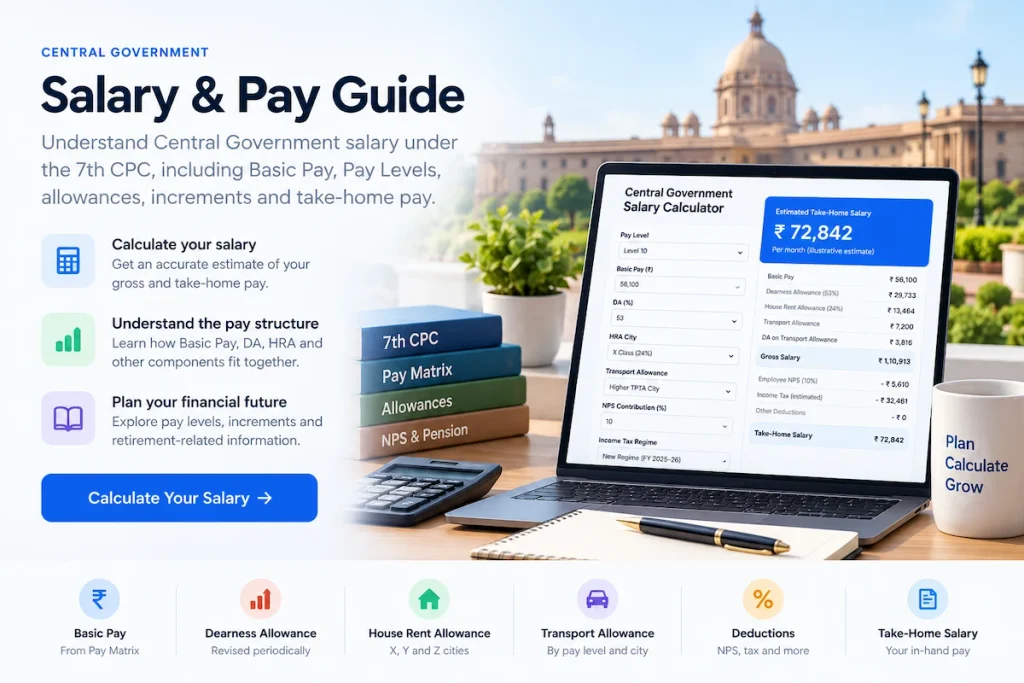
Use the Central Government Salary Calculator to estimate Basic Pay, DA, HRA, Transport Allowance, NPS, income tax and monthly take-home salary.
How Is Central Government Salary Calculated?
For a typical Central Government employee covered by the 7th CPC pay structure, monthly earnings can broadly be represented as:
Gross Salary = Basic Pay + DA + HRA + Transport Allowance + DA on Transport Allowance + Other Applicable Allowances
Gross salary, however, is not the same as the amount credited to the employee’s bank account.
Applicable deductions must then be considered:
Take-Home Salary = Gross Salary − Employee Deductions
Depending on the employee, deductions may include NPS contribution, income tax/TDS, CGEGIS and other applicable recoveries.
This means that two employees with the same Basic Pay may not necessarily receive exactly the same take-home salary.
Their location, HRA classification, Transport Allowance entitlement, pension arrangement, taxation and other deductions can affect the final amount.
Understanding the 7th CPC Pay Structure
The 7th Central Pay Commission replaced the earlier system of Pay Bands and Grade Pay with a Pay Matrix.
The matrix organises Basic Pay into different Pay Levels. An employee occupies a particular level according to the applicable post or pay entitlement and a particular cell within that level represents the employee’s Basic Pay.
The Central Civil Services (Revised Pay) Rules, 2016 contain the Pay Matrix used for the revised pay structure. The Government subsequently modified Level 13 through the CCS (Revised Pay) (Amendment) Rules, 2017.
What Is a Pay Level?
A Pay Level represents a vertical column of the 7th CPC Pay Matrix.
The matrix runs from Level 1 to Level 18, with Level 13A also forming part of the structure.
For example:
| Pay Level | Starting Basic Pay |
|---|---|
| Level 1 | ₹18,000 |
| Level 2 | ₹19,900 |
| Level 3 | ₹21,700 |
| Level 4 | ₹25,500 |
| Level 5 | ₹29,200 |
| Level 6 | ₹35,400 |
| Level 7 | ₹44,900 |
| Level 8 | ₹47,600 |
| Level 9 | ₹53,100 |
| Level 10 | ₹56,100 |
| Level 11 | ₹67,700 |
| Level 12 | ₹78,800 |
| Level 13 | ₹1,23,100 |
| Level 13A | ₹1,31,100 |
| Level 14 | ₹1,44,200 |
| Level 15 | ₹1,82,200 |
| Level 16 | ₹2,05,400 |
| Level 17 | ₹2,25,000 |
| Level 18 | ₹2,50,000 |
These are the first cells of the respective levels, not the only Basic Pay possible at each level. An employee normally progresses through the cells of the applicable level as increments are granted.
Coming next: 7th CPC Pay Matrix – Complete Levels 1 to 18
What Is Basic Pay?
Basic Pay is the pay drawn at the applicable cell of an employee’s Pay Level in the Pay Matrix.
It is one of the most important figures in a Central Government salary because several other salary components are calculated with reference to Basic Pay.
For example, Dearness Allowance is calculated as a percentage of Basic Pay, while HRA rates are also applied to Basic Pay for eligible employees.
Basic Pay should therefore not be confused with either gross salary or take-home salary.
If an employee has:
Basic Pay = ₹56,100
that does not mean the employee’s monthly earnings are limited to ₹56,100. Applicable allowances are added to Basic Pay before arriving at gross salary.
Major Components of Central Government Salary
1. Dearness Allowance (DA)
Dearness Allowance is paid in addition to Basic Pay and is intended to compensate for changes in the cost of living.
DA is expressed as a percentage of Basic Pay.
For example, at a DA rate of 60%:
DA = Basic Pay × 60%
For Basic Pay of ₹56,100:
₹56,100 × 60% = ₹33,660
The Department of Expenditure issued the revision of DA rates for Central Government employees effective from 1 January 2026.
Because DA changes periodically, salary calculations should use the rate applicable to the relevant period rather than treating any particular percentage as permanent.
2. House Rent Allowance (HRA)
Eligible Central Government employees may receive House Rent Allowance according to the classification of their place of posting.
For HRA purposes, cities are classified broadly as:
X Class
Y Class
Z Class
The applicable HRA percentage therefore depends on the employee’s posting and the prevailing HRA rules.
The Department of Expenditure maintains the relevant HRA orders and city-classification instructions, including its compendium of HRA instructions for Central Government employees.
HRA can consequently make a noticeable difference to gross salary between employees with the same Basic Pay who are posted in different locations.
3. Transport Allowance
Transport Allowance is another component that may form part of an employee’s monthly salary.
Under the 7th CPC framework, rates differ according to Pay Level and place of posting, including separate treatment for Higher TPTA cities and other places. DA is also applicable on Transport Allowance under the relevant structure.
For example, the 7th CPC framework provides different standard rates for employees in:
- Pay Levels 1 and 2
- Pay Levels 3 to 8
- Pay Level 9 and above
There are also specific provisions applicable in certain circumstances.
Because Transport Allowance eligibility can vary, PayCorpus calculators ask for the relevant posting category instead of applying one rate universally.
4. Other Allowances
Depending on the employee’s post, duties, location and applicable service rules, additional allowances may also be payable.
These are not identical for every Central Government employee.
For that reason, a general salary calculation should distinguish between the common salary components and allowances that apply only to particular employees or circumstances.
The PayCorpus Central Government Salary Calculator focuses primarily on the major components needed for a practical general salary estimate.
Gross Salary vs Take-Home Salary
These two terms are often used interchangeably, but they represent different amounts.
Gross Salary
Gross salary represents earnings before employee deductions.
A simplified calculation is:
Basic Pay + DA + HRA + Transport Allowance + DA on Transport Allowance + Other Applicable Earnings
Take-Home or In-Hand Salary
Take-home salary is the amount remaining after applicable deductions.
These can include:
- employee NPS contribution;
- estimated income tax/TDS;
- CGEGIS;
- recoveries or subscriptions; and
- other employee-specific deductions.
As a result:
A higher gross salary does not mean the entire amount is available as monthly disposable income.
How Does Annual Increment Work Under the 7th CPC?
The Pay Matrix makes annual progression relatively easy to visualise.
Under Rule 9 of the CCS (Revised Pay) Rules, 2016, an increment is represented by movement to the next vertical cell in the applicable Pay Level.
For example, the official rules illustrate an employee at:
Level 4 — Basic Pay ₹32,300 moving to Level 4 — Basic Pay ₹33,300 on grant of the increment.
This is why simply adding exactly 3% to the current Basic Pay does not always reproduce the final Pay Matrix value—the employee moves to the prescribed next cell.
When Is Annual Increment Granted?
The revised rules provide two dates for grant of increment:
1 January and 1 July
An employee is entitled to one annual increment on the applicable date, subject to the relevant rules governing appointment, promotion or financial upgradation.
What Happens to Pay on Promotion?
Promotion is different from a normal annual increment.
When an employee moves to a higher post or Pay Level, pay is fixed according to the applicable pay-fixation rules rather than simply replacing the existing Basic Pay with the first cell of the new level.
The exact outcome depends on the employee’s existing Basic Pay, the new level, the applicable fixation provisions and relevant dates.
The Department of Expenditure maintains separate material covering fixation of pay and related clarifications under the revised pay structure.
Explore Central Government Salary by Pay Level
Explore commonly referenced Pay Levels below. As individual guides are published, this section will provide detailed Basic Pay, allowance and estimated take-home salary information for each level.
Pay Level 6
Pay Level 7
Pay Level 8
Pay Level 10
Pay Level 11
Pay Level 12
Pay Level 13
Pay Level 13A
Pay Level 14 & Above
Rather than reproducing the same salary figure for everyone, these guides will show how salary varies with Basic Pay, DA, HRA classification, Transport Allowance and deductions.
Our first detailed level guides will include Pay Level 10 and Pay Level 12.
Central Government Salary Calculator
If you already know your Pay Level and Basic Pay, you don’t need to calculate each salary component manually.
The PayCorpus calculator lets you select:
- Pay Level
- Basic Pay
- DA
- HRA city classification
- Transport Allowance posting
- NPS
- income-tax treatment
- other monthly deductions
It then estimates:
- Basic Pay
- DA
- HRA
- Transport Allowance
- DA on Transport Allowance
- gross monthly salary
- employee NPS contribution
- estimated income tax
- Government NPS contribution
- estimated take-home salary
- next Basic Pay in the Pay Matrix
Example: Level 10 employee with ₹56,100 Basic Pay (calculated as of September 2026)
| Component | Example |
|---|---|
| Basic Pay | ₹56,100 |
| DA | ₹33,660 |
| HRA | ₹16,830 (X-City) |
| Transport Allowance | ₹7,200 (X-City) |
| Gross Salary | ₹1,18,110 |
| Deductions | ₹8,976 |
| Take-home | ₹1,09,134 |
Example assumptions: Level 10 Basic Pay of ₹56,100, DA at 60%, X-class HRA, Higher TPTA City and NPS coverage. Under the New Tax Regime for AY 2026–27, estimated income tax is nil in this example after applicable deductions and rebate. Actual take-home pay may vary depending on tax circumstances and other deductions.
Salary & Pay Guides on PayCorpus
Central Government Salary Calculator
Estimate your monthly gross and take-home salary using your actual Pay Level, Basic Pay, DA, HRA and applicable deductions.
7th CPC Pay Matrix
View Basic Pay across Pay Levels 1–18 and understand how employees progress through Pay Matrix cells.
Coming Next
Pay Level 10 Salary
Understand Level 10 Basic Pay, increments, allowances and estimated monthly salary.
Coming Soon
Pay Level 12 Salary
Explore Level 12 Basic Pay progression and estimated gross and take-home salary.
Coming Soon
Dearness Allowance
Understand how DA is calculated and how a revision affects monthly salary.
Coming Soon
HRA for Central Government Employees
Understand X, Y and Z city classifications, applicable HRA rates and salary impact.
Coming Soon
Frequently Asked Questions
What is the minimum Basic Pay under the 7th CPC?
The first cell of Pay Level 1 is ₹18,000, which is the lowest Basic Pay shown in the 7th CPC Pay Matrix under the CCS (Revised Pay) Rules, 2016.
What is the highest pay in the 7th CPC Pay Matrix?
Level 18 provides a fixed Basic Pay of ₹2,50,000 in the Pay Matrix.
Is Basic Pay the same as gross salary?
No. Basic Pay is one component of salary. Gross salary can additionally include DA, HRA, Transport Allowance and other applicable earnings.
Is gross salary the same as in-hand salary?
No. Gross salary is calculated before employee deductions. In-hand or take-home salary is the amount remaining after applicable deductions such as NPS, income tax and other recoveries.
Does DA increase Basic Pay?
DA increases an employee’s monthly earnings but does not ordinarily change the Basic Pay cell itself. Basic Pay progresses according to the applicable Pay Matrix and pay-fixation rules.
Does everyone in the same Pay Level receive the same salary?
No. Employees within the same Pay Level can occupy different Basic Pay cells. Their HRA classification, Transport Allowance entitlement, deductions and other applicable allowances may also differ.
How can I calculate my Central Government salary?
Select your Pay Level and current Basic Pay in the PayCorpus Central Government Salary Calculator, enter the applicable DA and allowance options, and the calculator will estimate gross salary, deductions and monthly take-home pay.
Official Sources & Methodology
PayCorpus aims to use primary Government sources when explaining Central Government pay.
The principal references for this guide include the Central Civil Services (Revised Pay) Rules, 2016, subsequent amendments and clarifications, and allowance orders published by the Department of Expenditure, Ministry of Finance.
Useful official reference:
Department of Expenditure — Central Pay Commission Orders
Pay and allowance rules can change. PayCorpus therefore distinguishes current official rules from estimates, scenarios and future proposals wherever relevant.
Last reviewed: September 2026